
My Grandparents Kisan ko Katha
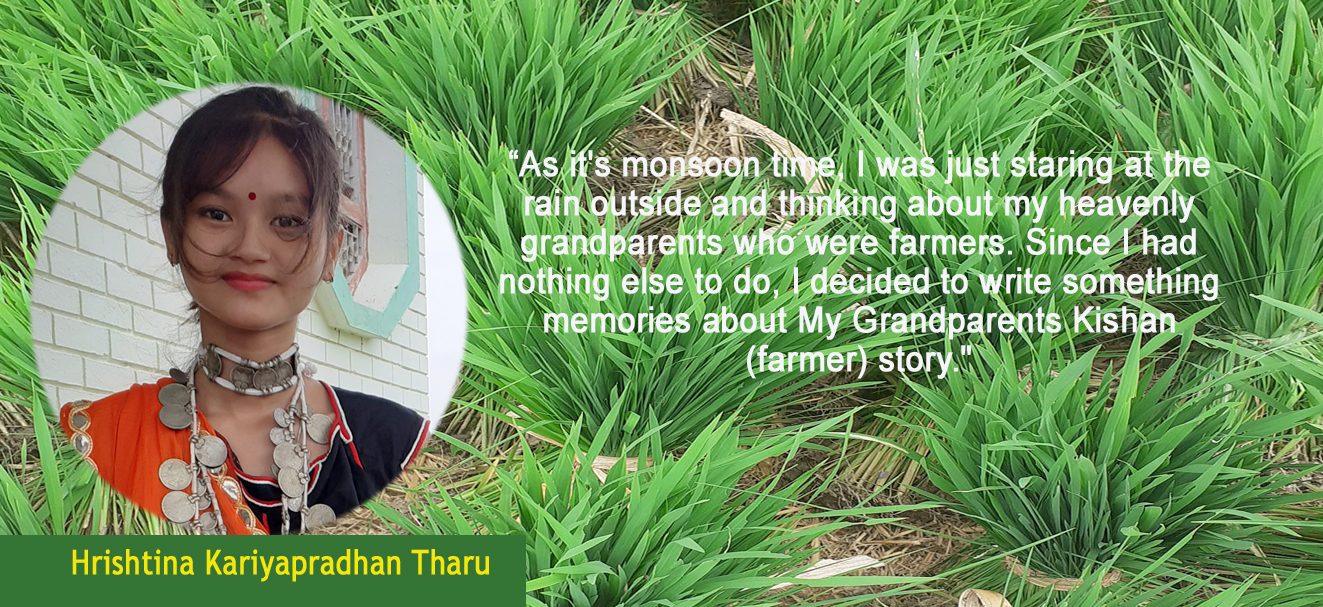
As it’s monsoon time, I was just staring at the rain outside and thinking about my heavenly grandparents who were farmers. Since I had nothing else to do, I decided to write something memories about my grandparents a Kishan’s (farmers) story.”
I remember, when I was childhood maybe 3 or 4 years old, I used to hear the conversation of my parents (धान लगैना बा होई, गाउ जाईक परि). These conversations were regarding about planting and harvesting the paddy in our home village. There are different types of farmer but in this monsoon season farmers are mostly focused on planting paddy rice, as we used to live in city area Dhangadhi, in this time we had to go to our village Pahalmanpur for helping my grandparents in the farm. Before, there were no any advance agricultural technologies and equipment’s as now. So my grandfather used to go to the jungle in the search of wood for making the native tools which would help his field work easy like, Haar (Halo), Phar, Juwa, Kilwahi, Henga and other tools makes the field plough for more productive to plant. My grandfather only used the organic fertilizer from the cow dung or the wastes of vegetables. During the period, He used to scatter the rice seed placed on the paddock and just put on some bushes or banana leafs upon it kept it with the stone or brick to make them feel warm and after some days if the seeds grows a bit then he took off those bushes and stones. That was the primitive process of growing seed of paddies.
“I have a hilarious memory from when my sister was very young, just about two or three years old, she joined our father working in the rice paddy fields. While he operated the Henga, she ended up buried in mud a moment of time, playing around with the same tool. It was such an amusing moment!”
I also remember my grandfather was the (किसनवा) head of the family and he was also very known personality in the village. Before there was no time calendar and weather forecast tools; we only had a Toyanath Patro. My grandfather used to Toyanath patro to know weather forecast so villagers were come to our house asking my grandfather how much it will rain this year and he used to answer every question logically through used to Toyanath Patro.I also remember my grandmother used to grind the paddy in the dhikki as there was no other machinery in the village for ‘Barkhaiya Tayari’. She used to grind it all the night for the future use in Barkhaiya (monsoon) period. She also used to buy every basic foods or needs to use in the monsoon period as it was very hard that time to go again to market and buy it because the market was also very far and more importantly sometime flood ruin the way too. Before my villagers used to say that, they will go to LIKMA MELA first then only they will start to pant the rice in the field. You know why because there was goods exchange system, they used to exchange their rice, wheat, Masuri with other veggies like potatoes, onions and many other food items for future use in monsoon. Like now, farmers plant or scatter some seeds on field and when they grow and reach to the maximum point, those plant are harvest and again planted to the field but earlier, people used to have a lot of land, 30 bighas and 50 bighas and they just used to scatter rice seeds in the fields and let the seeds grow by themselves. One seed consists only one plant because of that many seeds were wasted before. Farmers needed 1 quintal of more of seeds for their field before as they had a lot of lands and field in comparison of current period so that now they can just use 5 or 10 kilograms or needed of seeds for planting rice. I have belonged Tharu community girl; I remember in my village those planters also used to sang “Sajna” songs while planting the paddies, they believe that it will rain and make their rice herbs cultivate quicker. In this days people have a feeling of unity and no discrimination in themselves as everyone all the farmers, people who are working abroad far from their family. They gather at home during this time and plant rice without any feeling of jealousy and angriness. Sajna is an emotions of an individual, it is a type of folk song of the tharu community from which a person describe about their feelings. Like if a family member (husband or any male) is out of the town or the country and if they are unable to come, then wife beloved or a female or any family member sang Sajna in the memory of that family member and if a woman sang Sajna in her in-laws place while planting those paddies, it means that she is missing her biological family. So Sajna is a type of typical folk song of Tharu community made by own self which is very much connected to an individual’s emotions. If we complete our Dhan ropayi first then we go to our neighborhood to provide them helping hand in the completion of their field. It also built mutual understanding and also good relationships with neighborhood. After the completion of the Dhan ropayi (planting rice paddy), in that day we colleague play ‘Lewa Khel’ with mud forgetting every sorrows we had suffered and after that all the community’s people gather together and celebrate the completion of their farm. After the Completion the Dhan Ropayi, a day joyous celebration program that celebration is called as Hardouhuwa. This festival is celebrated only if all the community’s people finished their Dhan ropayi in their field otherwise they help them to finish it and celebrate together. In the Hardouhuwa celebration prepares typcial tharu foods Khariya, Fish, Ghonghi, Surik Masu(pig meat) and local wine Jaanr Daru etc. They are invited people who helped in the rice planters including relatives too.
I remember the so typical GAIYA BEHARNA Program in my village. This event organized in the tharu community when comes dried of monsoon. It is very primitive program of tharu community. In GAIYA BEHARNA event, a group of Women used to transformed themselves to men through wearing male dress up and go to another village and kidnap the Bharmansha of that village not in serious but in an entertaining way. Bharmansha is known as the head of a particular Tharu community. The highjack Bhalmasha or women representative of Bhalmansha keep in another village as guest. They respectively honor him/her in the home as special guest. While returning to own village they go to other house entertain them and to ask for some vegetables like bottle gourd, brinjal, and many other veggies they have in their house. After that, from the village where the Bharmansha of the village were requested to kidnap, the villagers go to the village where the bharmansha was kidnapped to get their Bharmansha. After that, there is a competition of folk song (Sajna) among the villagers and only if, those villagers win then they can take their Bharmansha to their own village. It’s a really fun activities playing together, having fun, and drinking dancing singing along with our family and also with other villagers. They believe, God will bring monsoon soon for their farm.
Farmers used to celebrate this Dhan Ropayi season as a festival before but now time changed people migrate to big cities with their huge dreams and they got other works to do. People also don’t have much land like before. Some built a house, some invested their immense wealth, and some even sold land for money. As I remember, Asad 15 the Farmer’s Day or Dhan Ropayi was celebrated. That day, I saw many types of farmers on social Medias. They never goes to the farm to see how their parents work, but that day they got time to showoff and took 10 photos and post it with the captions as “Happy Farmer’s Day”. People only like to flex things out maybe just for a second and it’s also good to share their things to people but only if they have knowledge about it. Though there are many genuine farmers out there in village who work very hard to earn their livelihood.
I heard every year, the government allocates a budget for the development of farmers’ areas and agricultural sector, but we do not know where the budget goes. While Nepal is an agricultural country, there is still no development in agricultural sector. There is no fund, no subsidies loan given to the farmers for better work. Though; we import the vegetables, rice and other dairy product from other country even though we are rich in it. There are no better seeds, fertilizers, insecticides, pesticides, transportation facilities and many more others. If government is allocating the budget fund for agriculture then, they have to make sure that what the main problem and it has to be solved right away. If Nepal government is contributing 1 lakh in a certain year then in another year, there should be an increase of 1.5 lakh. Nepal have to work a lot on this terms hope it will be improve soon.


