
Sickle Cell Trait: Could it be a Risk Factor for Severe Coronavirus?
Sickle Cell Trait affects 18% Aborigines and Indigenous people in Nepal. Could it increase the risk of death from Coronavirus?
Sickle Cell Disease and Sickle Cell Trait
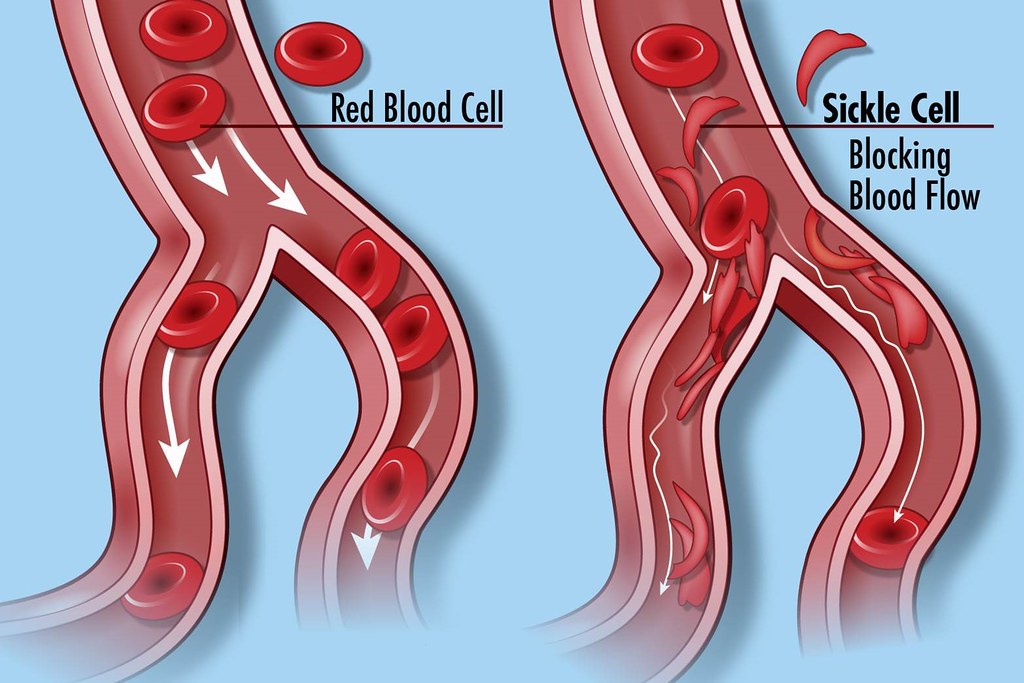
Sickle Cell Disease is a group of inherited disorders that cause a hemoglobin abnormality. Hemoglobin is the molecule found inside red blood cells (RBCs) that carry oxygen around the body. This abnormality causes the hemoglobin molecules to stick to each other, bending the red blood cells into an abnormal “sickle”-shape. Sickled cells can block capillaries and venules, causing acute pain, starving body tissues of oxygen and damaging vital organs. Sickle cell disease is also associated with other complications, including Acute Chest Syndrome, a severe lung injury with similar presentation to the Acute Respiratory Distress Syndrome (ARDS) seen in critically ill Coronavirus patients.
Sickled red blood cells block blood flow through capillaries and venues. Image by ByBruceBlaus (Own work, CC BY-SA 4.0)
Top image: normal red blood cells flow through a capillary. Lower image: sickled cells blocking the capillary.
Sickle Cell Disease is a genetic disorder. Affected individuals inherit two mutant copies of the β-globin gene, one from each parent. Individuals with just one mutant β-globin gene have Sickle Cell Trait. Having Sickle Cell Trait provides some protection against malaria, so it is highly prevalent in places where malaria is endemic: approximately 300 million people worldwide, including 30% of people from West Africa and 20% of people from eastern Saudi Arabia have Sickle Cell Trait. Moreover, in the United States, 8% of African Americans have Sickle Cell Trait, compared with 0.05% of White Americans.In Nepal the study and research has shown that the rate of sickle cell trait prevalence is 16%-18% among aborigines and indigenous communities. According to the research conducted by Pokhara University in Kailali District of Far Western Province of Nepal the rate of sickle cell trait prevalence is 12%. The report of WHO(1990) shows that particularly inhabitants: Tharu and Chaudhary communities (aborigines and indigenous people) of Dang, Banke. Bardiya, Kailali and Kanchanpur have been mostly affected by sickle cell disease and several others are likely to be affected if efforts are not made on time to prevent it.

writer : pitamber chaudhary
Diagram showing the autosomal recessive inheritance pattern of sickle cell disease and sickle cell trait
Inheritance pattern for Sickle Cell Trait and Sickle Cell Disease. Image from Wikipedia by Cburnett (Own work in Inkscape) CC BY-SA 3.0
Although Sickle Cell Trait has no population-level impact on life expectancy, it is not completely harmless. Among other risks, people with Sickle Cell Trait have a 28-fold higher risk of sudden exercise-related death; and are at risk of developing illness at high altitude. There are also cases of individuals with Sickle Cell Trait developing Acute Chest Syndrome. Although these complications are rare, they are associated with conditions where the body doesn’t get enough oxygen. In these conditions, people with Sickle Cell Trait can experience the haemoglobinpolymerisation and red blood cell sickling that is so dangerous in Sickle Cell Disease.
Covid-19 Coronavirus and Sickle Cell Trait
Covid-19 corona virus is an acute infection of the respiratory tract. Although many patients experience only mild or asymptomatic disease, aproximately 13% of patients require hospitalization, with hypoxemia and respiratory failure are the main causes of hospitalization. One of the main symptoms of severe Coronavirus is severe hypoxemia (lack of oxygen in the blood), including an atypical “silent” hypoxemia, likened to altitude sickness , in which the patient displays severely reduced blood oxygen saturation, but without the reduced lung compliance and respiratory distress typical of severe ARDS. Acute Chest Syndrome and Vaso-occlusive crisis have also been observed in Coronavirus-positive people with homozygous Sickle Cell Disease, even in the absence of respiratory complaints.
Sickle Cell carriers are at risk of death or serious illness under conditions of physiological stress that can induce sickling. It is possible that Coronavirus infection and Coronavirus pneumonia, which cause hypoxemia and resultant tissue hypoxia, could induce these conditions. This strongly suggests that people with Sickle Cell Trait may be at considerably enhanced risk of death or severe disease from Coronavirus infection.
Furthermore, if we see the data, African American individuals are hugely over-represented among Coronavirus hospitalizations and fatalities in America. In Louisiana, approximately 70% of Coronavirus fatalities are in people of African American heritage, despite making up only one third of the population. There are likely to be many intersecting reasons for this discrepancy, including structural racism, reduced access to medical care, a higher risk of co-morbidities and potentially an increased likelihood of Coronavirus exposure during essential work duties.
However, considering that 8% of African Americans have Sickle Cell Trait, we can’t ignore its possible contribution to Coronavirus-related hospitalizations and fatalities. To do so would be to compound the existing systematic disadvantages faced by African Americans needing medical care.
(Source: Sleepy geek, data scientist and psychology student, Rebecca Murphy’s Article appeared on April 18, 2020)
Unlike several countries in Europe where death rate is higher due to the infection of corona virus, the present situation of Nepal seems to be better despite the low number of people infected by Covid-19. That is to say, so far 31 cases have been declared to have corona virus infection though no death has been caused by it. However, WHO has declared that Nepal is at high risk of covid-19 and therefore it should follow WHO guidelines and preventive measures on time, otherwise a slight mistake can help it spread nationwide and this pandemic of corona virus can make the situation dreadful and severe like that of America, Spain, Italy and other European countries. Eventuallyindividuals of sickle cell trait will surely be affected to greater extent and it will be too late to control it. It is because we lack enough health facilities: no more hospitals with sufficient infrastructure, medical equipment, team of skilled men power andso on all over the country. Particularly Tharu and Chaudhary communities (aborigines and indigenous) who are living under the line of poverty are at high risk of corona virus infection. Among them 18% have already been affected by sickle cell disease and many others have a chance to inherit it from their parents. Their financial condition is very poor, so they do not have access to hospitals and sickle cell clinics. Nor they can afford to pay for diagnosis and treatment. Besides, many of them are still unaware and unconscious of it.
Screening for Sickle Cell is performed routinely in Nepal in different intervals, but at present, regarding the death in America and other European countries, the relationship between Sickle Cell Trait and death from coronavirus is currently completely unknown. This data must exist. So it should be addressed.If Sickle Cell Trait doesn’t increase the risk of severe disease and death, we will be in the same position as we are now. But if it does, that’s something we can act on to save lives.
*Individuals with Sickle Cell Trait should fully self-isolate themselves to avoid exposure to the Coronavirus.
*Hospital admission thresholds could be lowered for symptomatic individuals with Sickle Cell Trait to enable rapid intervention if needed.
*The high prevalence of Sickle Cell trait in many regions of the developing world could be a major public health concern.
Right now, we just don’t know. But this must be something worth. Therefore realizing the fact it is very urgent to raise fund for these people. Here our organization Sickle Cell Anemia Association of Nepal (SCAAN) appeals all the people nationally and globally for donation in the name ofCovid-19Relief Fund for Sickle Cell Trait Individuals. This very effort if we make with unity will help us, no doubt,raise a fund and will be a key weapon to fight against covid-19 corona virus. Our effort will prove to be much helpful to save the life of such marginalized, helpless and needy aborigines and indigenous communities. This is a wonderful job together we must dofor humanity. The donation collected in the fund will be fully utilizedin coordination with the government of Nepal for covid-19 patients of sickle cell trait and those who are likely to be infected.We are committed that as it is the situation in which each and every individual has to spontaneously dedicate themselves towards the sake of humanity, the relief program will be carried out with transparency, honesty and great sincerity. We assure all the people that our organization is legally registered and has been working and doing advocacy in this field for quite a long time. For more information kindly contact the following responsible officials and members:
Mr. PitamberChaudhary (President of SCAAN)-cell no. +977-9848420421
Mr. PremBahadurThapa (Senior Advisor of the Board)-cell no. +977-9848771648
Our Focal Persons:
Mr. MahavirChaudhary (USA)
Mr. BhogendraChaudhary (USA)
Mr. Deepak Khuna (USA)
Mr. DeependraThapa (Australia)
Mr. SudeshChaudhary (Australia)
Mr. SumanChaudhary (Australia)
Mr. KanailalChaudharyBasudevchaudhary (Japan)
For your kind consideration, please send us your message and suggestion if any
Our email address:[email protected] and [email protected]
Name of the fund: Covid-19 Relief Fund for Sickle Cell Trait Individuals.
Name of the bank: Bank of Kathmandu
Bank account number: 01-06-00001430-524,
Address: Belauri Municipality-04, Kanchanpur, Far Western Province, Nepal..
Note: please do not forget to send the voucher or the document of the amount you transferred into our account via the email address aforementioned.


